Where Kids Learn to Compete, On the Court and In Life

A Case for Support of H3-Sports
A Leap of Faith
In 2022, Sid Newcomb's wife faced a difficult surgery. Coach Sid stepped away from his role with the USPTA to care for her, and the timing gave him something he had not expected, a few months to think about what came next.
His instinct was to go back to what he knew. He built a resume, started interviewing, and flew out to look at director positions at clubs around the country, including a beautiful club in Kentucky and another just outside Denver. Three clubs offered him the job. Twenty years in the private tennis world made that path the obvious one.
Then his old college roommate Sean came to visit. The two of them grabbed coffee and went for a walk around Lake Nona. Sean brought up something Coach Sid had talked about on and off for thirty years, working with underserved kids and building athletes who did not have the advantages that come with wealth. Now is the time, Sean told him. He asked Coach Sid what it would take. He named a number, just enough to get by. Sean offered to cover two months. Then, without even checking with his own business partner first, Sean doubled it. Four months, fully funded.
Coach Sid went home and told Linda. He wondered if she was on board. She did not hesitate. “You have talked about this forever,” she said. “You have to do it.” Apparently, she had been listening the whole time.
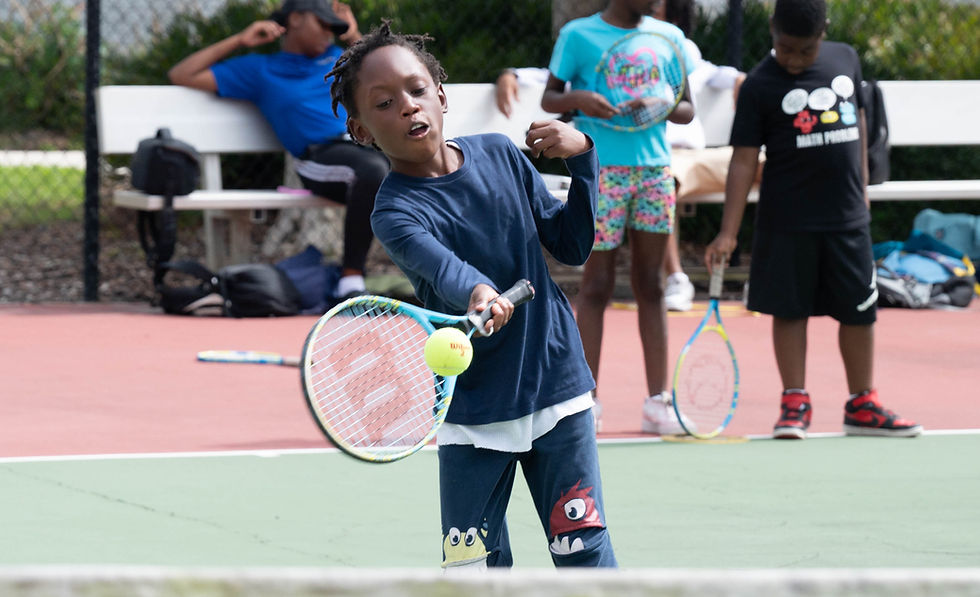
H3 Sports officially launched in June of 2023, with after school tennis at Rock Lake Neighborhood Community Center in Orlando. For the first year, the program operated under the fiscal sponsorship of Footsteps Missions, another nonprofit where Coach Sid serves on the board. Coach Sid set a simple test for himself. If the program could not sustain itself past a year, he would go back to looking for a tennis director job. If it could, H3 Sports would become its own independent 501(c)(3). The program sustained itself, and H3 Sports has stood on its own ever since.
Why Coach Sid Cares
Coach Sid's commitment to this work traces back to childhood. At the age of ten, his father's career as an Air Force pilot took the family to Santiago, Chile, where his dad trained pilots on aircraft the United States had recently sold to the country. Coach Sid landed in a completely new world. He learned Spanish. He learned soccer. And through a small local church in a modest village one of his parents found and grew close to, he made a group of friends his own age who loved soccer and marbles just as much as he did.
As the families grew to trust each other, Coach Sid started spending entire Sundays at his friends' homes, playing marbles on dirt floors in simple houses with wood walls and cots for beds. He remembers showing up the first time ready to play soccer in his cleats and socks, only to find his friends played barefoot. He never brought the cleats again. One of his closest friends visited Coach Sid's house once and treated it like a trip to Disneyland, which left Coach Sid feeling more at home in his friend's world than his own. Kids the same age, the same love of the game, the same easy friendship, and yet such different starting points. That contrast never left him.
The thread continued into college. After a season at the D1 level, Coach Sid made the decision to transfer to John Brown University, a small college in Arkansas. During his very first days on campus, he encountered the university's guiding motto, Head, Heart, and Hand, a framework that would eventually shape everything he built at H3 Sports. He also walked onto the basketball team there during a rebuilding season for the program, a small piece of the same story. Someone willing to show up and compete for a spot rather than wait for one to be handed to him.
Every summer during those college years, Coach Sid worked with a ministry called Inner City Youth for Christ, spending one summer in inner city Houston and another in inner city Kansas City. The programming was always built around sport, basketball in Kansas City, soccer in Houston, because sport was the hook. It earned trust fast. Kids wanted to be around someone who could play or coach, someone who was not there to sell them anything. After practice, the group would gather for what was called a stop and talk, a short moment to share something personal, a Bible verse, a story, a piece of encouragement. Coach Sid still uses that exact phrase today, stop and talk, at every H3 Sports session. The model he learned as a twenty year old in Houston and Kansas City is the same one running at Rock Lake right now.
How Rock Lake Happened
Coach Sid found his way to Rock Lake almost by accident. Always looking to stay involved, he picked up a short term weekend coaching assignment through his long relationship with Orlando City Soccer, running a four week Friday soccer program for kids at the Rock Lake Community Center on a court Orlando City had converted from tennis to outdoor futsal, painted purple with soccer goals installed. Beside it sat one remaining tennis court that went unused.
On his first day, Coach Sid took a picture of that empty tennis court and went looking for whoever ran the center. He introduced himself as a tennis coach and asked if anyone had ever run a tennis program there. The center director told him she had worked there seven years and the only thing that court had ever seen was the occasional water balloon fight. She would love a real tennis program. Six weeks later, H3 Sports had its first home. Coach Sid calls it a serendipitous story. However you want to explain it, it is the moment an empty court in downtown Orlando found a purpose.
The Framework: Head, Heart, Hand
Coach Sid first heard the phrase Head, Heart, and Hand during transfer orientation at John Brown University in 1989, and the university applied it to everything, academics, student government, clubs, sports. It stuck with him for over three decades before it became the backbone of H3 Sports.
He breaks it down simply. Head is the mind, the appetite to learn and engage rather than coast. Coaches at H3 Sports work to engage kids intellectually on the court, not just physically. Hand is the physical part, both the training that builds strength and quickness, and the follow through, the willingness to actually put your hands to work and reach out to other people. Heart is the motivation underneath it all, the reason a person does the work in the first place, whether that is personal satisfaction or the deeper reward that comes from helping someone else grow.
What Coach Sid loves most about the framework, beyond the fact that it lines up neatly with a program called H3, is how broadly it applies. Head, Heart, and Hand works on a tennis court with a seven year old, and it works just as well for an adult asking whether they are bringing their whole self to their career, whether they are an accountant, a salesperson, or anything else. It is a framework built for a complete person, not just an athlete.
A Program Built on Trust
The primary aim at H3 Sports has never been to build tennis players. It is to build character, and Coach Sid says that plainly. Tennis is the hook that gets kids in the door and keeps them coming back. What happens after the hook is where the real work lives.
Every session includes a stop and talk, usually called after kids are hot, sweaty, and ready for a water break. The group finds shade and talks through the word of the week, a character value tied directly to something they just practiced. It took a couple of weeks for kids to trust the routine when the program first started. Now, after more than two years, they ask for it. Coach Sid describes kids showing up and immediately asking what the word of the week is, eager for the conversation as much as the tennis.
He points to trying hard as a favorite example. Every second grader can tell you exactly what trying hard means on a tennis court. The interesting part comes seconds later, when a coach asks where else in life that same idea applies. Hands go up almost instantly, and the answers, even from the youngest kids, carry more insight than you would expect watching them chase a ball around a court. Fifth graders, Coach Sid says, are the real standouts in these conversations, sharp thinkers.
Tennis and Tutoring, Together
H3 Sports built its after school model on an idea borrowed from East Palo Alto Tennis and Tutoring, a program that started decades ago with a single Stanford All America and has since grown into a multi million dollar organization. The concept is simple. Teach kids character and discipline through tennis, but pair it with real academic support, because character alone does not open doors without academic proficiency to go with it.
At Rock Lake, the after school program serves second through fifth graders, and it is fully subsidized so cost is never a barrier for any family. Every student who plays tennis commits to an equal number of hours in academic tutoring, taught in a classroom setting by certified Florida teachers, some full time, some early career educators building experience. If a student is falling behind in the classroom or needs to focus more attention there for a stretch, they step back from tennis until they are caught up, a decision made together by Coach Sid and the center's director. Once a student is back on track, they return to the court.
Coach Sid is quick to point out that this is never treated as punishment. It is a lesson in priorities, and one that plenty of kids come to embrace on their own. He talks with real affection about students who move in and out of tennis eligibility over a season, working hard every time to earn their way back. Tennis, in this program, is something you earn, and that framing changes how kids treat it.
Watching Kids Grow
Three years into the program, Coach Sid does not claim to have formal outcomes data, but the change he sees firsthand is real. Kids who started as second graders are finishing fifth grade now, and they know the coaches by name, understand the expectations, and look forward to the relationships as much as the sport itself. They know the rules and they hold themselves to them.
Where Coach Sid sees the clearest opportunity for growth is competitive skill. Right now, coaching capacity is limited, so most kids get group instruction rather than the individualized attention that develops a stronger player. Coach Sid is candid about this and treats it as the next chapter rather than a shortcoming. These are kids with real athletic ability, the same raw talent as any junior player in the region. They simply need more coaching hours to turn that talent into results.
Building Toward Competition
H3 Sports recently launched an early version of what Coach Sid calls the Tennis Club, a smaller group made up of students who have shown real progress and enthusiasm for the game, meeting for extra practice time outside the main program. It is the first step toward something bigger, a true junior development pathway.
Coach Sid's goal is for kids who grow up in this program to walk onto their zoned high school teams and hold their own, not just fill out a roster. Right now, many downtown Orlando high schools struggle to field competitive tennis teams simply because so few kids in the area have had access to real instruction. Coach Sid wants H3 Sports alumni to change that, and he already has relationships with downtown high school coaches who are enthusiastic about the idea and eager to receive players who know how to compete.
Getting there takes more coaching capacity, more individualized attention, and more structured opportunities like Saturday programs and small group lessons. It is the same recipe that builds strong junior players anywhere. These kids simply have not had access to it yet.
Where H3 Sports Is Headed
Coach Sid's next step is hiring a second full time coach. That coach would help lead the broader after school program at Rock Lake while also starting to identify a small group of committed players, roughly six kids between the ages of seven and nine, and build a true development pathway around them. That work is intensive. It means building relationships with guardians, arranging transportation, covering tournament entry fees, and asking families to commit to something bigger than an after school activity.
From there, Coach Sid wants to replicate the entire model, the tennis, the tutoring, the stop and talk, at a second location in Orlando, following the same pattern that worked at Rock Lake. Start broad, build trust, get kids excited about the sport, then layer in more individualized development over time.
His five year vision is clear and specific. He wants to see H3 Sports alumni, boys and girls, competing on varsity teams at their zoned high schools, not just showing up but actually competing, the kind of team other schools have to prepare for. Beyond that sits the goal that drives everything else. A student from this program earning a college tennis scholarship. That is the outcome Coach Sid keeps coming back to, kids from this exact neighborhood playing college tennis somewhere, proof of what is possible when talent meets real opportunity.
Beyond Orlando: The Mission Trips
Alongside the after school program, H3 Sports runs international service trips built on a model Coach Sid has used for decades, ever since his first overseas trip at age twenty two with an organization called Sports Ambassadors. He has led more of these trips than he can count, in basketball, soccer, and now tennis, always centered on the same idea, going to serve, not to vacation, and staying humble enough to ask what a community actually needs rather than assuming.
The most recent trip took place in March 2026, when Coach Sid led fifteen students and five adult leaders to a remote village in Honduras, a place so far off the main roads that reaching it took twenty minutes over bumpy dirt roads from the nearest hotel. The group spent the week teaching tennis at a local elementary school and helping students practice English through bilingual books, building relationships with kids who rarely see visitors from outside the village at all.
Later in the trip, the group traveled three hours to the capital to train and compete at the national tennis center, playing matches against members of Honduras's national team. Coach Sid arranged for one of the H3 players to address the team afterward, thanking them for their time and sharing a bit about the week in the village. What was meant to be a ten minute exchange stretched to twenty, full of questions from the national team players curious about the trip and the village the students had just come from.
The full cost per traveler for the week ran about $1,700, covering flights, lodging, meals, and ground transportation. Students raise the funds themselves, ahead of three virtual training sessions that prepare them for the trip. That process matters as much as the trip itself. When kids raise the money themselves, they understand exactly what it took to get there. They see how many people believed in them before they ever stepped on a plane. That appreciation shows up all week, in how hard they work and how much they thank the people who host them.
Coach Sid describes the group's final evening in the village, when community members, a Catholic priest, a Protestant pastor, and neighbors gathered to say goodbye, and students shared what the week had meant to them. As the group's bus pulled away at dusk, kids ran alongside it down the dirt road, reaching out for one last high five through the windows. The van stayed completely silent the whole ride out. Coach Sid has led something close to a hundred of these trips over the years, and he says every single one carries a moment like that.
Why This Work Matters
Coach Sid believes people are wired to want to be part of something good. Not everyone can coach after school three days a week, and not everyone can join a mission trip to Honduras. Both take a kind of availability most people simply do not have. But everyone can be part of the story in another way, by hearing it, by praying for it, and by giving financially, because that is what makes all of it possible.
He comes back to one image when he talks about what support really means. Five years from now, a donor watching a student who grew up at Rock Lake compete in college tennis, knowing they played a real part in making that happen. These kids bring the same talent and the same heart as kids anywhere. What they need is a community willing to invest in giving them the same chance.

Comments